More Than a Preschool: A Glimpse Inside the Montessori Pre-K Classroom
Selecting the right Pre-K program is one of the most important decisions a parent can make. When you choose Montessori, you are choosing more than just a school – you are choosing an environment carefully designed to match the way your child naturally learns.
Between the ages of three and five, children are in what Dr. Maria Montessori called “sensitive periods,” a time when their minds are eager to absorb language, order, movement, and social skills. Our Pre-K classroom is built to nurture that incredible potential.
Building Confidence Through Real-World Skills
The heart of our Pre-K classroom is Practical Life. These are not just chores; they are powerful exercises that build focus, confidence, and independence. Children love to master the real-world skills they see adults doing every day.
- Fine Motor Control: Activities like pouring, spooning, and threading build hand strength and coordination, which are the foundational skills needed for writing.
- Responsibility: Lessons in caring for the environment, like watering a plant or sweeping the floor, teach children to be respectful and contributing members of their community.
- Social Skills: Our Grace and Courtesy lessons are integrated into daily life, helping children learn how to greet others, wait their turn, and use polite words, building a strong foundation for positive social interactions.
Exploring the World: How Sensorial Work Builds the Brain
Sensorial materials are designed to help children sharpen their senses to classify, compare, and understand the world around them. This work is fascinating for children and also prepares their brains for abstract thinking.
- Materials like the Pink Tower and Knobless Cylinders help children visually discriminate between different sizes and dimensions, laying the groundwork for mathematical concepts.
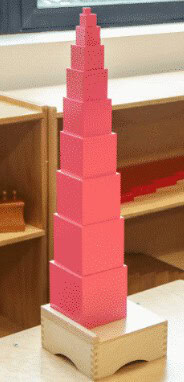
The iconic Pink Tower teaches children to discriminate size in three dimensions.
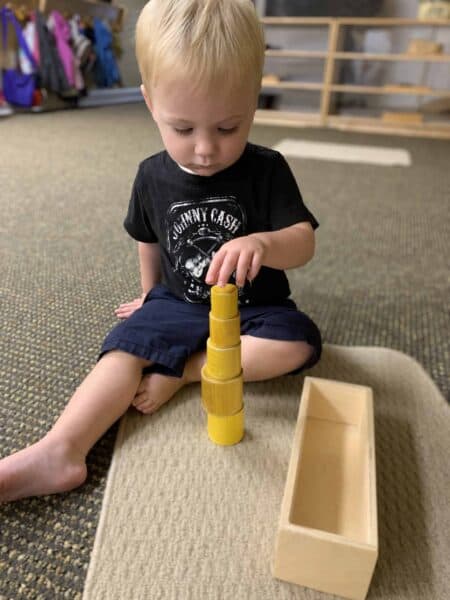
A student focuses on visual discrimination of size using the Yellow Knobless Cylinders.
- Working with the Color Tablets and other materials refines a child’s sensory perception while naturally expanding their vocabulary.
- As Dr. Montessori said, “The senses, being explorers of the world, open the way to knowledge.”
From Sounds to Stories: A Joyful Path to Reading & Writing
Our Pre-K program surrounds children with rich language experiences that are both tactile and joyful, allowing them to learn at their own pace.
- The famous Montessori Sandpaper Letters and Moveable Alphabet engage touch, sight, and sound. This multi-sensory approach allows children to connect symbols with sounds and often begin spelling words long before they can comfortably hold a pencil.
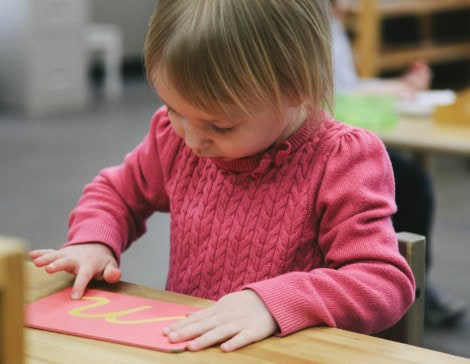
A preschool child focused on sandpaper tracing at a classroom table, highlighting hands-on learning and early childhood education in Mount Clemens, MI.
- We expand vocabulary with Classified Cards and objects, exploring everything from the names of geometric solids to the parts of a leaf, sparking curiosity in science and geography.
Beyond Memorization: Building a True Understanding of Math
In a Montessori classroom, math begins with concrete, hands-on experiences, not abstract memorization. This ensures a deep and lasting understanding.
- Materials like the Number Rods and Spindle Boxes make the concept of quantity visible and tangible.
- Activities with Cards and Counters allow children to physically see and feel the difference between even and odd numbers.
- The Bead Chains are a colorful, engaging way to introduce sequential counting and lay the foundation for understanding multiplication.
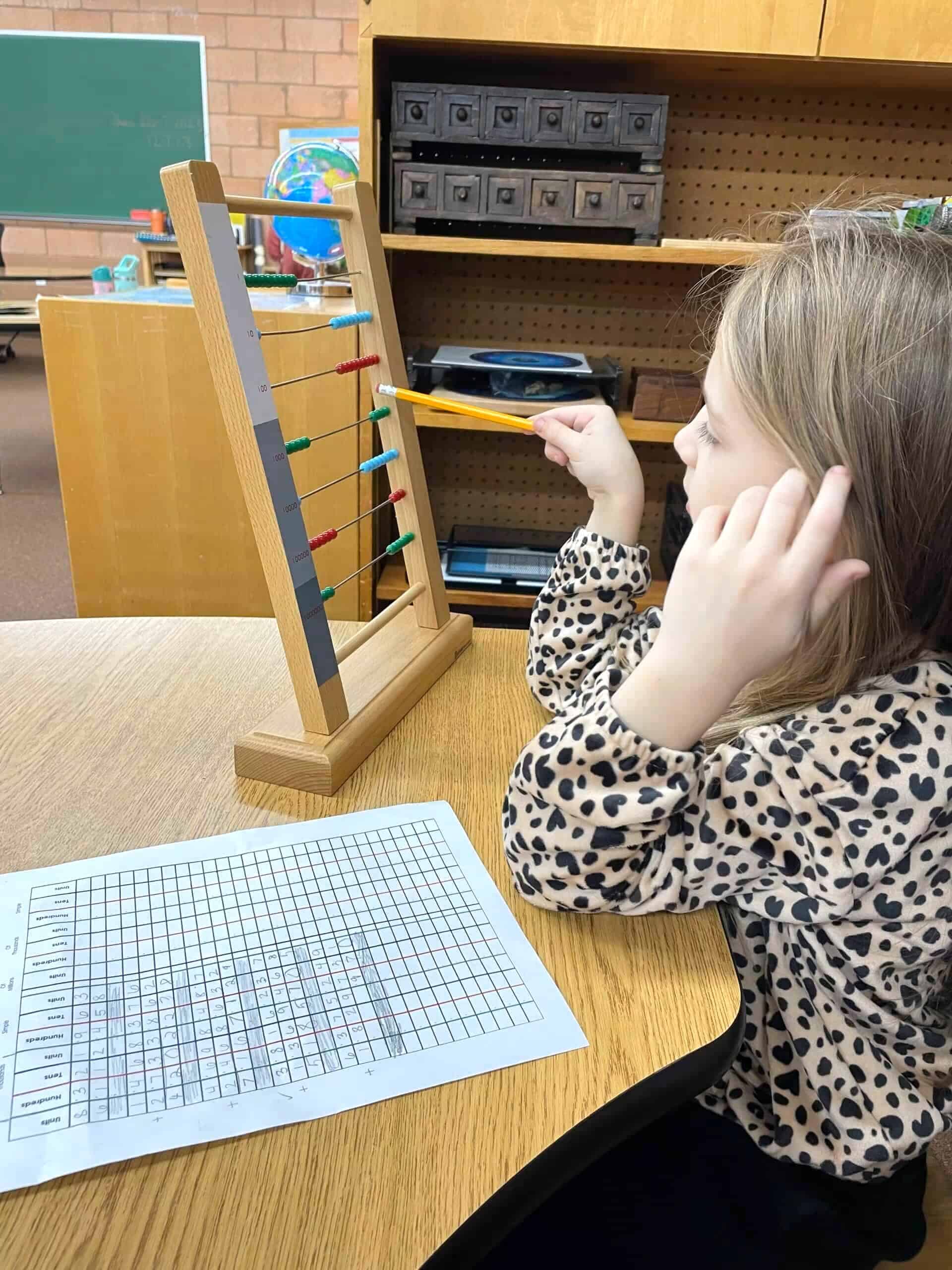
Elementary student using the Montessori Large Bead Frame to solve a math problem on graph paper.
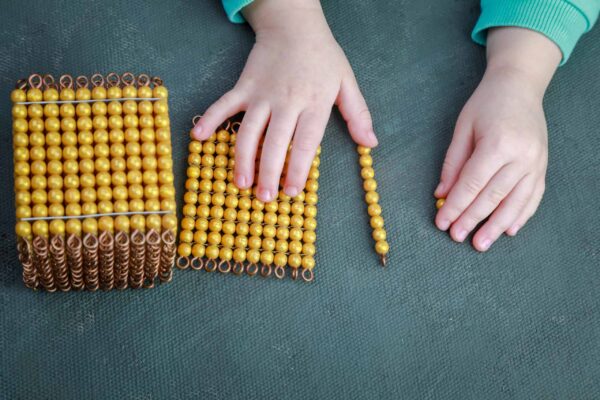
Making math concrete: The Montessori golden bead materials allow students to physically experience the decimal system, helping them grasp complex concepts of quantity and place value in a tangible way.
The Montessori Difference is a Foundation for Life
A Montessori Pre-K education is about so much more than academic readiness. It’s about nurturing a curious, confident, and independent child who loves to learn. This foundation prepares them not just for kindergarten, but for a lifetime of success.
Please check out our blog and FAQ pages to find out additional benefits of a Montessori education – or contact us by clicking on the button below!
Discover the Montessori Difference Yourself
The best way to understand the Montessori difference is to see it for yourself. We invite you to check out our Pre-K classrooms in action and discover if Montessori Stepping Stones is the right fit for your family.