Is It Magic or Is It Science? How We Teach Reading.
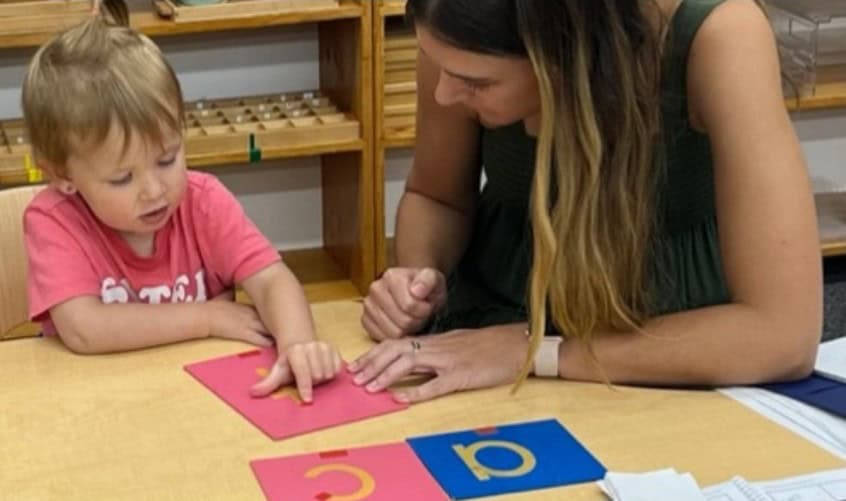
Montessori teacher working one-on-one with a preschool student on letter sounds and phonics in Mount Clemens.
Parents often walk into our Mount Clemens Preschool classrooms and ask, “How will my child learn to ready?”
It can look like magic – but it is actually a carefully designed method that aligns perfectly with what modern research calls the “Science of Reading.”
In a Montessori classroom, we don’t force reading through rote memorization or boring worksheets. Instead, we use a hands-on, sensory-based approach that builds the neural connections a child needs to become a fluent, confident reader.
1. The Science of Reading: Montessori Was Ahead of Her Time
Decades of research have confirmed that effective reading instruction requires Phonics (connecting sounds to letters) and Phonemic Awareness (understanding that words are made up of sounds).
Maria Montessori discovered this over 100 years ago, and she observed that children learn by doing. As she famously stated, “What the hand does, the mind remembers.”
We engage the brain by engaging the hands.
2. It Starts with Sounds (Phonemic Awareness)
Before a child ever sees the letter “A,” they learn the sound “ah.”
We play games like “I Spy” using sounds. “I spy with my little eye something on the table that starts with ‘buh’.” This trains the ear to hear individual sounds in words – a critical first step that many traditional programs skip.
3. The Sandpaper Letters: Feeling the Sound
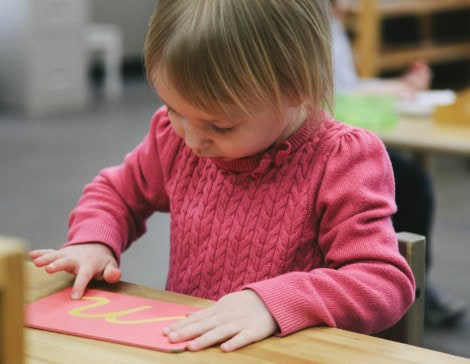
Close up of a preschool child tracing the cursive sandpaper letter ‘m’ to build muscle memory for writing.
Once a child can hear the sounds, we introduce the symbols using Sandpaper Letters. This is a multi-sensory experience:
- They See it: They look at the letter shape.
- They Say it: They repeat the sound (phonics).
- They Feel it: They trace the textured letter with their fingers.
By linking touch, sight, and sound simultaneously, the child creates a strong “muscle memory” for the alphabet.
4. The Moveable Alphabet: Writing Before Reading
This is often the most surprising part for parents: In Montessori, writing often comes before reading.
Once a child knows their sounds, they use the Moveable Alphabet – a box of wooden letters – to “write” their thoughts. A child might sound out “C-A-T” and find those three letters to place on a rug.
They are encoding language (building words) before they have the motor skills to control a pencil. This builds immense confidence! They realize, “I can communicate my thoughts with these symbols.”
5. Phonetic Object Boxes: The “Aha!” Moment
As the child gets comfortable building words, they naturally begin to “decode” or read them back. To practice, we use Phonetic Object Boxes.
These are small baskets containing tiny objects (like a miniature fan, a pin, or a lid) and matching labels. The child reads the label and matches it to the object. This ensures that reading is always connected to meaning and comprehension, not just barking at print.
Bringing the “Science of Reading” Home
You don’t need a full classroom of materials to support your child’s reading journey at home. Here are four easy ways to build these skills tonight:
- Play Sound Games: “I’m thinking of a fruit that starts with ‘buh’ (Banana).”
- Focus on Sounds, Not Names: When you see the letter B, say “buh” instead of “Bee.” This helps with sounding out words later.
- Read Daily: Read meaningful books to them to build their vocabulary.
- Write Real Notes: Ask your child to help you write a grocery list. Even if they just write the first letter of “Milk,” celebrate it!
See It In Action
Reading shouldn’t be a struggle. When children learn through their hands and senses, they don’t just learn how to read – they learn to love reading!
Want to see the Moveable Alphabet in action?
We invite you to tour our Mount Clemens campus and observe how our students build literacy skills with joy.