Why Montessori? The Science of a Smarter Start
Most parents worry about the same thing: Is my child just memorizing, or are they actually learning? Traditional classrooms often rely on textbooks and “sit-still-and-listen” teaching. In contrast, the Montessori method – backed by the research in Angeline Lillard’s The Science behind the Genius – is designed to match how a child’s brain actually develops.
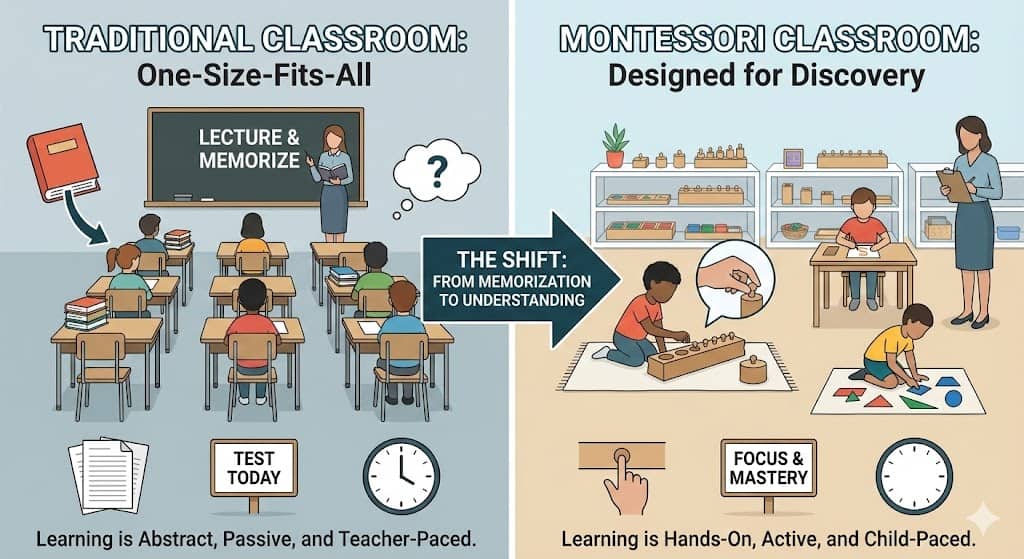
The Shift: How Montessori moves from passive memorization to active, child-paced mastery.
Here is why that shift in environment makes a massive difference for your child.
1. Hard Skills through “Hidden” Practice
In Montessori, children don’t just “learn to write”; they prepare to write.
-
The Secret: Activities like lifting knobbed cylinders or tracing shapes aren’t just play – they develop the pincer grip and wrist coordination months before a child ever holds a pencil.
-
Why You Should Care: By the time your child starts writing, the physical struggle is gone. They don’t get frustrated or fatigued; they just start writing.
2. Concentration Over Chaos
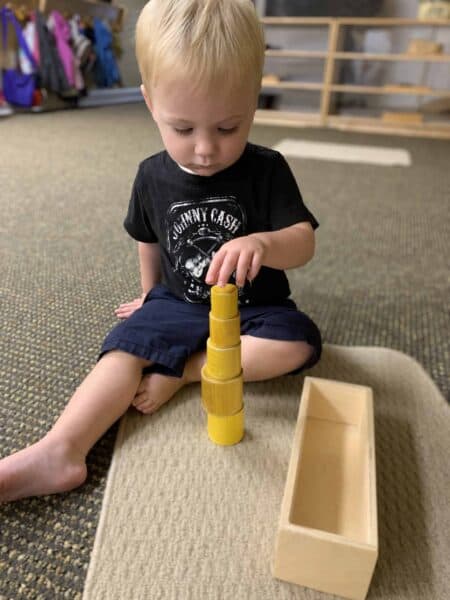
A student focuses on visual discrimination of size using the Yellow Knobless Cylinders.
Walk into a Montessori room and you’ll notice the deep focus?
-
The Environment: Children choose their own work and where to sit (even on the floor with small rugs). Materials are beautiful, wooden, and kept in a precise, “pristine” order.
-
Why You Should Care: Research shows that orderly environments lead to better child outcomes. Your child learns to “protect” their own concentration and respect the work of others – foundational skills for leadership and emotional intelligence.
3. Mastery Without the Pressure of Testing
Traditional schools use tests to see if a child “got it.” Montessori uses observation.
-
The Method: Teachers watch how a child interacts with materials. If they use a tool “wrong,” it’s a signal they aren’t ready for the next step. If they master it, they move on immediately.
-
Why You Should Care: Your child is never bored by repetitive work they’ve already mastered, and never stressed by being pushed into concepts they don’t yet understand. It’s a custom-paced education without the “high-stakes” anxiety.
4. The “Spontaneous” Reader
Because Montessori breaks complex tasks (like reading) into tiny, manageable steps, the final result often feels like a “lightbulb” moment for the child.
-
The Science: By learning phonetic sounds through touch (sandpaper letters) and movement, reading emerges naturally rather than through laborious drills.
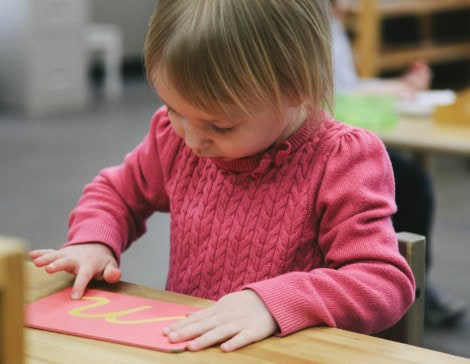
A preschool child focused on sandpaper tracing at a classroom table, highlighting hands-on learning and early childhood education in Mount Clemens, MI.
-
Why You Should Care: Early reading success is the strongest predictor of high school vocabulary and comprehension. Montessori makes this process painless, ensuring your child associates learning with joy, not a chore.
The Bottom Line:
Montessori isn’t just a different “style” of school; it’s a task-analyzed system that treats your child like the capable, focused individual they are.
Read our post “What are the Differences Between Montessori and Traditional Education?” for additional information!
Ready to Unlock Your Child’s Full Potential?
Every child is born with an innate desire to learn and explore. Our classrooms are designed to protect that spark rather than extinguish it. Come see how we prepare the “whole child” for a lifetime of success.