“The senses, being explorers of the world, open the way to knowledge.”
Maria Montessori
The sensorial materials are one of the most unique parts of a Montessori classroom. Their purpose is simple yet effective. They help children refine their senses so they can better understand the world around them.
In early childhood, children are curious about every sound, texture, and color they observe. Sensorial materials give that curiosity a clear direction. Each activity allows children to classify, compare, and name what they experience. This builds vocabulary, focus, and problem-solving skills. It also indirectly prepares the mind for math and science.
Visual Discrimination: Size and Dimension
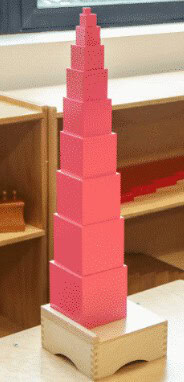
The Pink Tower (Visualizing Volume)
The Pink Tower is perhaps the most iconic Montessori material. It consists of ten pink wooden cubes ranging from one cubic centimeter to ten cubic centimeters. The child’s work is to build a tower, placing the largest cube at the bottom and the smallest at the top.
Why it matters: This material teaches the child to discriminate differences in three-dimensional size (volume). As they carefully stack the cubes, they are refining their fine motor control and visually experiencing the decimal system (base 10) long before they ever learn the numbers for it.

The Brown Stair (Understanding Thickness)
While the Pink Tower varies in three dimensions, the Brown Stair (or Broad Stair) varies in only two: height and width. The length of these sections remains constant. The child arranges them from thickest to thinnest, creating a stair-like structure.
Why it matters: This activity isolates the concept of “thickness.” It helps the child develop the muscular memory of different weights and the visual ability to distinguish fine gradations in width, preparing the hand for holding a pencil.
The Red Rods (Perceiving Length)
The Red Rods vary in only one dimension: length. The child carries these rods one by one (which engages large muscle movement) and arranges them from longest to shortest.
Why it matters: By physically handling the “long” and “short” rods, the child gains a concrete understanding of linear measurement. This fosters a sense of order and lays the groundwork for understanding the number line in mathematics.

Refining the Senses: Sound, Color, and Smell
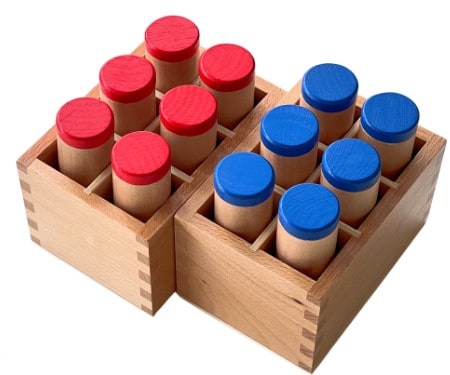
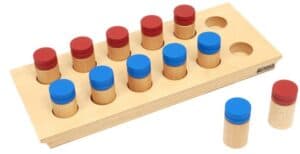
The Sound Cylinders (Auditory Matching)
This material consists of two boxes, each containing six wooden cylinders. When shaken, each cylinder produces a sound ranging from soft to loud. The child’s task is to shake the cylinders and find the matching pair that makes the exact same sound.
Why it matters: In a world filled with noise, this material teaches children to listen with intent. It refines auditory discrimination and prepares the ear to distinguish the subtle phonetic sounds used in reading and language.

The Color Tablets (Visual Grading)
The Color Tablets move beyond simple matching. The box contains tablets differing grades of different colors. The child must arrange the tablets to create a beautiful gradient, moving from the darkest shade to the lightest tint.
Why it matters: This activity is visually stimulating and highly calming. It refines the child’s chromatic sense, helping them appreciate the nuances of color in their environment and art. It requires deep concentration to spot the slight differences between shades.
The Smelling Bottles (Olfactory Discovery)
The Smelling Bottles isolate the often-overlooked sense of smell. One set of jars contains distinct scents (such as coffee, cinnamon, or peppermint), and the child must match them to a second set containing the same scents.
Why it matters: This material connects the child to their environment in a new way. It builds vocabulary (sweet, pungent, earthy) and refines the olfactory sense, which is strongly linked to memory and taste.
How Sensorial Work Organizes the Mind
As the child engages with each of the sensorial materials, they are organizing their thoughts. They begin to recognize patterns, make logical connections, and think systematically.
This internal order becomes the foundation for later academic work. It supports math, language, and scientific reasoning because the child has already practiced sorting, sequencing, and classifying in a hands-on way.
How You Can Support at Home
Parents can continue sensorial learning at home in small, natural ways:
- Let your child help in the kitchen. Compare textures, smell spices, and pour water.
- Take walks together and talk about what you see, hear, and feel.
- Offer toys or household objects that involve sorting, matching, and comparing.
Sensorial learning is not limited to the classroom – it is a way of seeing the world with curiosity and care.
Would You Like to Learn More?
To see how these materials inspire a love of learning in our classrooms, we invite you to contact us!