
Why Montessori Kids Don’t Hate Math
Ask a room full of adults how they feel about math, and half of them will likely shudder. For many of us, math in school meant memorizing times tables, stressful timed tests, and abstract symbols on a chalkboard.
It doesn’t have to be that way.
In our Mount Clemens classrooms, you won’t see worksheets. Instead, you will see children holding math in their hands. By using concrete materials, we help children develop a “mathematical mind” and deep number sense before they ever hold a pencil.
1. Start with the Hands (Concrete Learning)
Neuroscience tells us that the hand is the instrument of the brain. Montessori math takes abstract concepts (like “quantity”) and makes them physical.
Before a child learns the symbol “10,” they hold a Number Rod that is exactly ten times longer than the “1” rod. They physically feel the difference in weight and length. They aren’t just memorizing; they are experiencing quantity through their senses.
2. The “Golden Beads”: Seeing the Decimal System
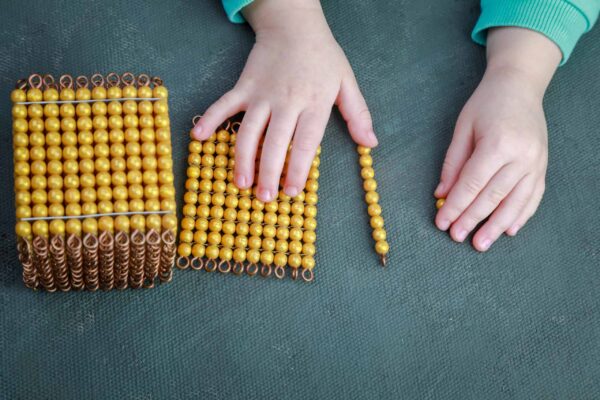
Making math concrete: The Montessori golden bead materials allow students to physically experience the decimal system, helping them grasp complex concepts of quantity and place value in a tangible way.
One of the most famous Montessori materials is the Golden Beads. This material introduces the decimal system (units, tens, hundreds, thousands) in a way a 4-year-old can understand.
- A Unit is a single bead.
- A Ten is a bar of ten beads strung together.
- A Hundred is a square of ten ten-bars.
- A Thousand is a cube of ten hundred-squares.
When a child holds a “Thousand Cube,” they feel its weight. They can visually see that it is made of 1,000 tiny units. This makes place value incredibly intuitive, preventing the confusion many children face in elementary school.
3. Operations: Doing “Big Math” Early
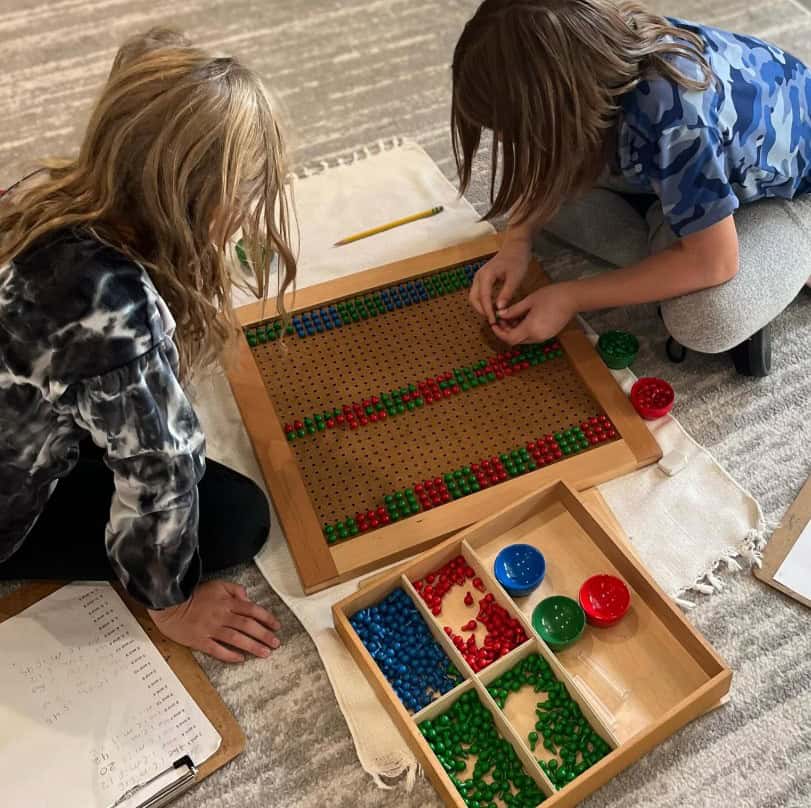
Math in Montessori is often collaborative. Here, students work together to solve complex problems using color-coded peg boards.
Because the materials are concrete, Montessori children often perform 4-digit addition, subtraction, multiplication, and division at ages 4 or 5.
It isn’t magic; it’s the materials. To add 1,200 and 2,400, a child simply puts one thousand-cube and two thousand-cubes on a mat and pushes them together. They count the result. They have just performed addition! Later, we introduce the symbols (numbers) to record what they just did.
4. From Concrete to Abstract
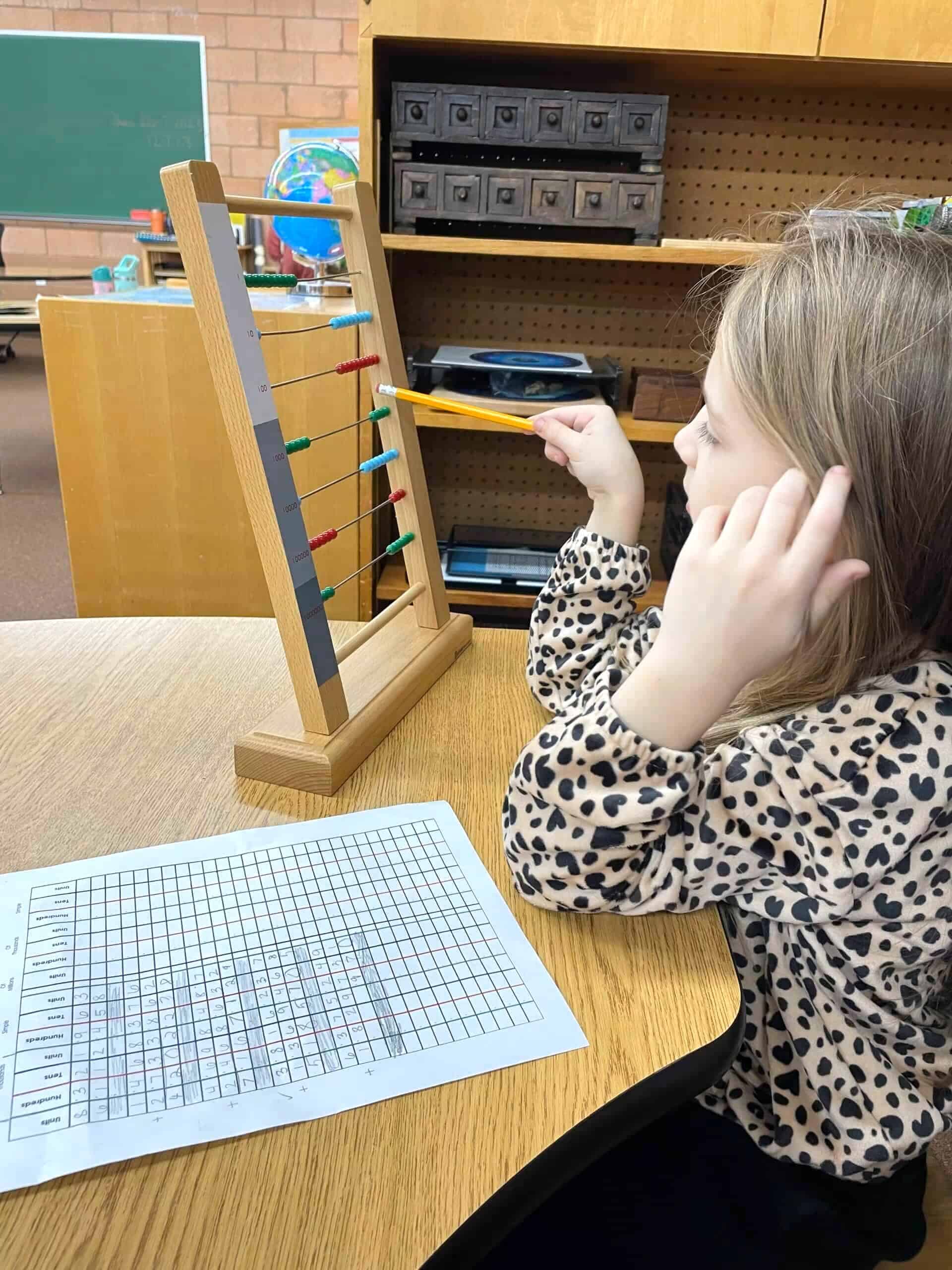
The Bead Frame acts as a bridge. This student is using the beads to find the answer, then recording it on paper – moving from concrete to abstract.
The ultimate goal is for the child to move away from the materials and do math in their head (abstractly). But we don’t rush this.
- Step 1: Concrete (Golden Beads)
- Step 2: Symbolic/Abstract Bridge (The Stamp Game & Bead Frame)
- Step 3: Abstract (Paper and Pencil)
By moving through these stages at their own pace, children build unshakable confidence. They don’t guess at answers; they know the answers because they have built them.
The Result: Confidence, Not Fear
Preschool student engaging with Montessori materials to promote fine motor skills and independence.
Our elementary students build a strong mathematical foundation through concrete materials like the spindle box, which helps them grasp concepts of quantity and number symbols in a tangible way. This hands-on approach makes learning math engaging and meaningful.[/caption]
Montessori math is designed to prevent “math anxiety.” There are no red pen corrections. Many materials are self-correcting, meaning the child can see if they made an error (e.g., the pieces don’t fit) and fix it themselves.
This fosters a growth mindset. Math becomes a puzzle to be solved, not a test to be feared.
See It in Action
It is hard to fully grasp the beauty of these materials without seeing a child use them. We invite you to schedule a tour of Montessori Stepping Stones to watch how our students explore the decimal system with joy.