“What subjects do the children learn each day?”
Every part of the environment works together to support the whole child. Academic growth, independence, concentration and social development unfold naturally as children explore each area at their own pace. This approach is grounded in Dr. Montessori’s idea of the Absorbent Mind. During these early years, children take in information effortlessly through hands-on experience and exploration, which is why the classroom is prepared so intentionally.
Below is a look at the main subjects in the Montessori Primary (preschool and kindergarten) classroom(s) and how each one supports early learning.
Practical Life
Practical Life is often called the heart of the Primary environment. These materials look familiar to children because they come from everyday life. Pouring, spooning, sweeping, scrubbing and preparing food help children develop coordination, independence and care for their environment. These activities strengthen focus and build the long attention span needed for future academic work.
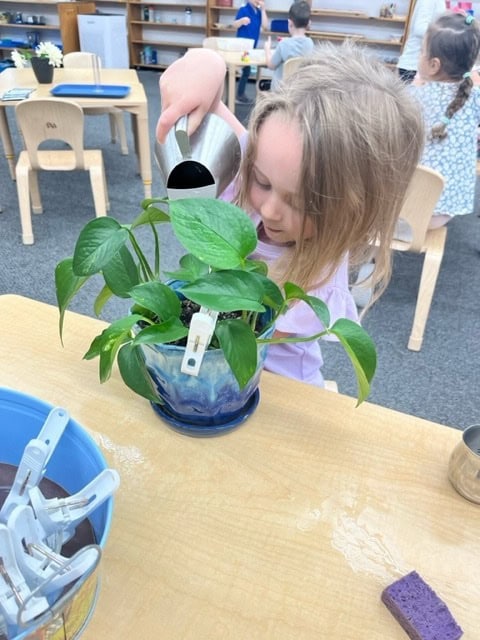
A preschool girl watering a plant using a metal pitcher as a Montessori Practical Life activity to develop fine motor skills and responsibility.
Sensorial
Sensorial materials help children refine their five senses. They compare size, weight, texture, color, sound and shape using beautifully designed Montessori materials like the Pink Tower, Brown Stair, Red Rods and Color Tablets. Through these activities children begin to classify, sort and order their experiences. This builds mental organization skills that support mathematics, language development and critical thinking.
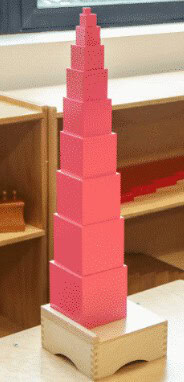
The iconic Pink Tower teaches children to discriminate size in three dimensions.
Language
Children explore sound games, classify objects and learn to express their thoughts clearly. As their interest grows, they work with sandpaper letters, the movable alphabet and early readers. The Montessori approach allows children to learn the sounds first, build words with hands-on materials and move into reading and writing when they are ready.
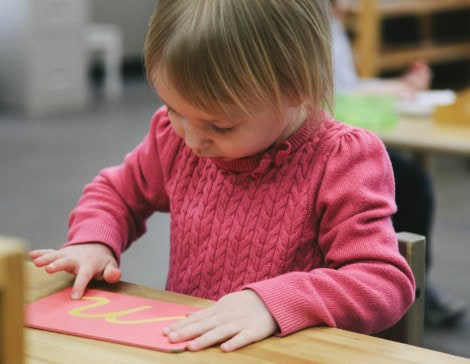
A preschool child focused on sandpaper tracing at a classroom table, highlighting hands-on learning and early childhood education in Mount Clemens, MI.
Mathematics
Math in the Primary classroom begins concretely. Children handle number rods, golden beads, spindle boxes and bead bars to understand quantity, symbol and place value. Instead of memorizing facts, they discover how numbers work by manipulating real materials. This gives them a deep understanding of addition, subtraction, multiplication and division long before these concepts appear on paper.
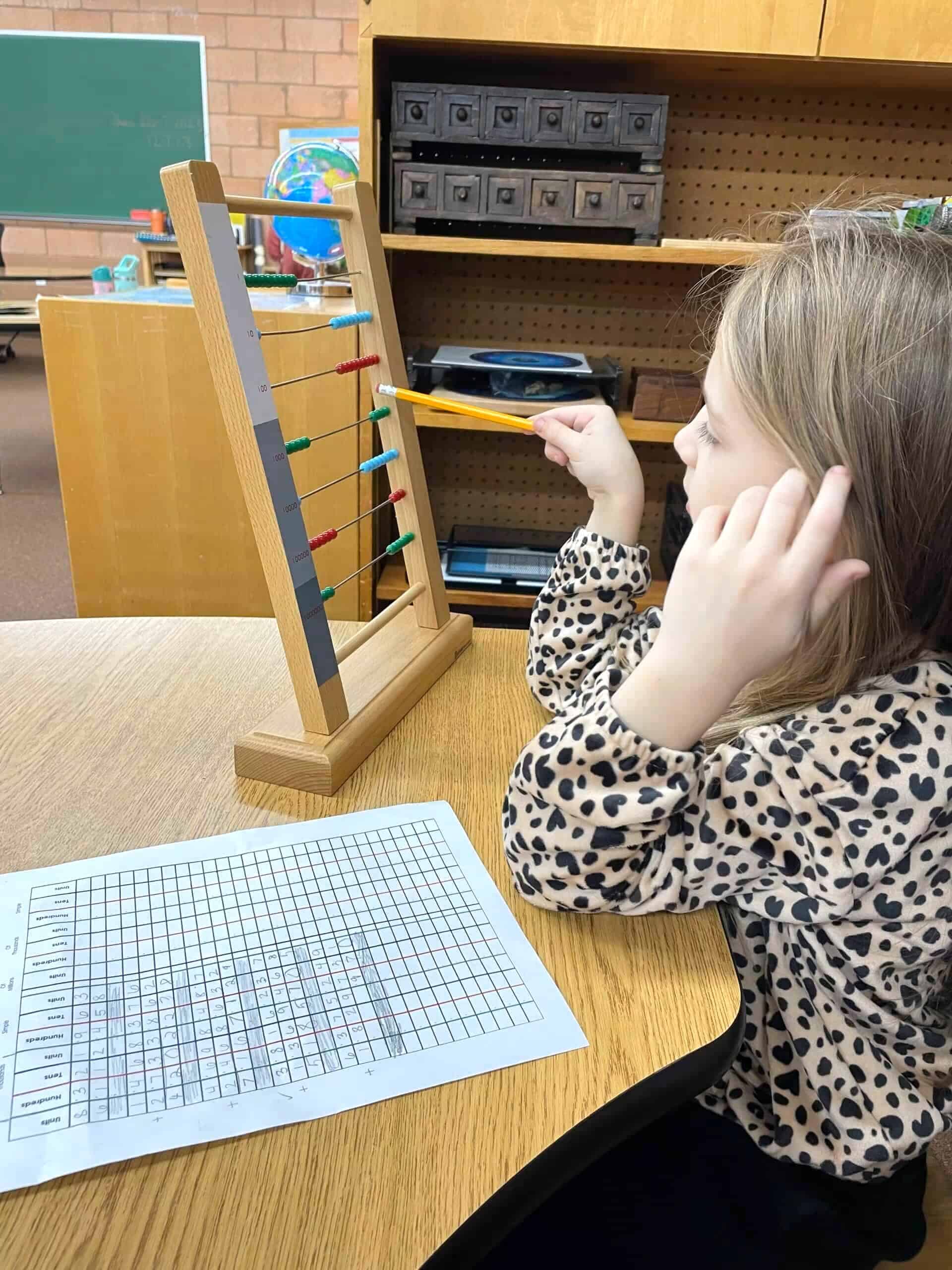
Elementary student using the Montessori Large Bead Frame to solve a math problem on graph paper.
Culture
The cultural area introduces children to the wider world. In Primary, this includes early geography, history, science and ecology. Children explore puzzle maps, land and water forms, parts of plants and animals and simple science experiments. These lessons help them see how everything in the world is connected.
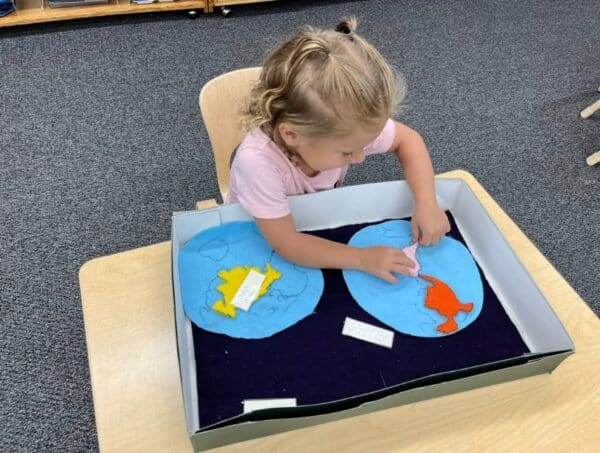
At Montessori Stepping Stones, we introduce concepts like geography early on through hands-on materials. Here, a student explores the continents using a felt puzzle map, building concentration and worldview simultaneously.
Art and Music
Creativity is an essential part of early childhood development. Children paint, draw, sew, explore sculpture and learn about famous artists. Music lessons include rhythm, singing and movement activities that allow them to express themselves and build coordination.
Outdoor Exploration
Movement and nature are central to Montessori education. Outdoor time allows children to run, climb, play, observe nature. This supports gross motor development, sensory awareness and a sense of peace.
More Than Just Playtime
At Montessori Stepping Stones, our Primary environment turns curiosity into capability. From practical life skills to early reading, we provide a foundation that traditional childcare and daycare centers simply cannot match. Come see how our infants, toddlers, and preschoolers thrive.